
By Anna Broome

Bill Gallagher has run a market research firm, launched two internet companies, led a jewelry brand through a decade of growth, built a $550M revenue program at Sprint, and coached more than 6,500 founders through the EO Accelerator program. Thirteen of his clients have sold their companies for more than $100M. And he’s coached three others past $1B in enterprise value, with a fourth one on the way.
But before all of that, he was a kid who surfed every day and DJed at clubs. He will tell you both things are relevant.
The thread connecting all of it—the operator decades, the coaching practice, the podcast, the book—is a single insight Bill arrived at by looking at himself honestly: in most of those companies he ran, he was the bottleneck. That realization didn't sideline him. It became the foundation of a coaching practice built on helping CEOs see the same thing in themselves before it costs them too much.
From Operator to Coach: The Long Way Around
Bill's path to coaching wasn't a pivot. It was a slow accumulation of evidence that the work he did best wasn't inside a company—it was helping the people running them think more clearly.
He had spent years coaching, speaking, and teaching on the side while running Lori Bonn Design, the jewelry company his wife Lori founded. By 2013, the two of them arrived at a fork: Bill wanted to scale up, Lori wanted to scale back. The solution was direct. Bill went full-time into coaching, and Lori got her company back the way she wanted to run it.
"Best decision we made for the marriage and for both businesses," Bill says.
He wasn't starting from scratch. By the time he went full-time, he had already trained in the four underlying skills he considers essential for effective coaching: facilitation, one-on-one coaching, teaching and training, and public speaking. He had also been using the Scaling Up Performance Platform in his own companies for years: not as something he'd studied, but as something he'd lived with and tested.
"The certification gave me a methodology and a community," he says. "It didn't have to teach me the craft. That's why I could move fast."
Why Scaling Up, and Why Not the Others
Bill looked carefully at the alternatives before committing to Scaling Up. He is unusually precise about why the others didn't fit.
EOS, he found, was too rigid in application and too tightly controlled on coach branding—and in his view, it was built to get the founder out of operations rather than to actually grow the company or sharpen strategy. Strategic Coach felt more focused on the leader's lifestyle and mindset than on the operating problems CEOs were bringing him. ICF-style coaching was familiar from his Landmark training but wasn't built for the business mechanics his clients needed.
"Scaling Up gave me a flexible toolkit instead of a strict recipe," he says, "and it was actually about growth. That's what I wanted to be in the room for."

That flexibility shows up in how he applies the platform. Bill leads with Strategy, then Execution, then People. He almost never opens with the One-Page Strategic Plan. The tool he leads with is the vision summary—core values, purpose, brand promises, BHAG, and a five-year vivid vision—because most growing companies have a working strategy they simply can't articulate. Getting the vision summary clean unlocks everything downstream: planning, hiring, culture, alignment. The 7 Strata comes in only once articulation is solid.
"The Four Decisions framework gives clients a complete map of the business," he explains, "but the order of operations is mine to choose based on what the company actually needs. That's why I can use the same toolkit on a company cracking $1M and a company pushing past $1B."
2 Gyms to 43 in Three and a Half Years
When Tony Hartl co-founded Undefeated Tribe, a Crunch Fitness franchise group based in Austin, he had already built and sold Planet Tan in 2008 and spent ten years away from operating. He came back in 2018, and he and Bill started working together when Undefeated Tribe had two or three gyms.
Three and a half years later, they had built it past 43 locations across Texas and Oklahoma, with a current plan to open roughly two new gyms per month on the path to 100.
"The strategy was mostly there when I arrived," Bill says. "Tony is sharp and had done the front-end thinking. We did some clarifying work at the top and then iterated on strategy as the model proved out. But the real work was People and Execution."
The company went from a few hundred employees to three thousand in a short window, now hiring over a thousand people a year. That meant building the hiring engine, the management processes, the leadership development, and the culture infrastructure to absorb that volume without losing what made the business work. Quarter after quarter, the job on the execution side was keeping a fast-scaling operation rowing in the same direction.
Today, Undefeated Tribe has 60 gyms open or under development. VMG Partners has taken a majority stake. Tony Hartl was named a 2024 EY Entrepreneur of the Year Gulf South finalist. When the VMG deal closed, Tony said it "made five people millionaires."
"That's the part of the work I care about most," Bill says. "When a founder builds it right, the team builds it with them, and the upside gets shared."
Tony Hartl's story is also one of the operator examples that grounds Bill's book, Busy Is Broken: a direct extension of the principle that drives his coaching: doing less is what actually creates scale.
The Real Bottleneck Is Usually the Leader
Bill's most consistent observation after years of coaching across industries, company sizes, and geographies is this: the Scaling Up Performance Platform is a phenomenal operating system, but it doesn't directly address the leadership style and habits of the person running the company. That gap is where companies get stuck.
"I know it's the gap because I was the gap when I was running my own companies," he says. "I had the tools, the rhythm, the metrics. What I didn't have was a clear-eyed view of how my own way of working was capping what the company could become."
The pattern he sees: a leader doing too much, the company unable to scale through them, and busyness being mistaken for productivity. The tools expose the bottleneck. But the work of removing it is personal.
"The company doesn't outgrow the leader," he says. "The leader has to outgrow themselves, or the company plateaus right at the level of their current operating style. Once a CEO is willing to do that work, the Scaling Up toolkit becomes a force multiplier. Without it, the tools just expose the same bottleneck more clearly."
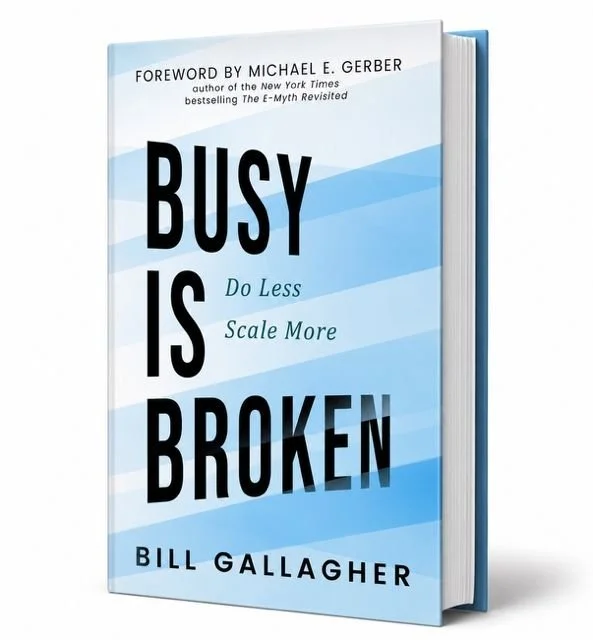
That belief sits at the center of Busy Is Broken, and it's the lens Bill applies to every client conversation. His phrase for it: Do less, scale more.
The Podcast, the Community, and the Full Circle
Bill hosts the Scaling Up Podcast, which he describes, without irony, as the DJ chair with a different microphone. The kid who worked club nights in college is now interviewing CEOs and thought leaders on growth, leadership, and scale. The through-line is the same: he was always drawn to the platform, the room, the conversation.
He is equally direct about what the Scaling Up coach community has given him. He's mentored incoming coaches, referred clients to peers when he wasn't the right fit, and co-led programs with Verne and other coaches in the network.
"The peer relationships matter more than any single tool in the toolkit," he says. "Coaching can be a lonely business if you let it. Having a room of people who do what you do, at your level, who you can call when a client situation is hard—that's the part you can't build alone."
And between client engagements, writing sessions, and podcast recordings, he still gets into the water about 100 days a year. Wing surfing. Skiing. The things he loved before he got serious, coming back now that he's stopped trying so hard.
"Full circle," he says. "And proof that the things you loved before you got serious tend to come find you again."
For Those Considering the Leap
Bill's advice to experienced leaders considering coaching runs through two filters, and he applies them bluntly.
The first: are you actually willing to coach, or do you want to be the boss? When you're coaching, you guide people through their decisions and let them do what they will with what they learn. You can't control the outcome. "If you still want to take the wheel," Bill says, "you're not done being an operator yet. And that's fine. Coaching is the wrong move at the wrong time."
The second: do a real skills audit. Speaking and presenting, most CEOs have some version of that. One-on-one advising, most have done informally. But facilitating a room and running a workshop are specific skills many executives have never built—and a coaching practice demands all four, constantly.
"The CEOs who flame out at coaching usually fail the first test, not the second," he says. "Skills you can build. The willingness to stop being the operator is a posture you either have or you don't."
His parting note for anyone weighing the decision: the pie is larger than it looks. The real competition isn't the coach in the next city running the same methodology. It's the CEO deciding to do nothing, hire a generalist, or keep grinding alone. The coaches who treat the certified community as a collaborative asset—who refer clients, share what's working, and co-lead when it serves the client—are the ones whose practices compound. The ones who compete inside the tent stay small.
"Pick the first posture from day one," he says. "It changes everything about how the business grows."
If you're an experienced executive or business leader considering certification as a Scaling Up Certified Coach, visit certification.scalingup.com to learn more about the program and download the official Coach Certification Guide.